


World-Class Shot Blasting Technology


Wheel (Changzhou) Intelligent

+
Wheel (Changzhou) Intelligent Manufacturing Co., Ltd.
World-Class Shot Blasting Technology

A roller conveyor shot blasting machine is a continuous, automated system. You use it to prepare flat and long parts' surfaces. Its main job is to take off rust, scale, and dirt. It also makes a smooth, even surface for coatings. Top makers like Wheel (Changzhou) Intelligent Manufacturing Co., Ltd. offer high-tech options. The RBS series is one good example.
This method is different from batch-type machines. Crawler-Type vs. Hook-Type machines clean parts in groups. Roller conveyor machines shine in high-volume work. They fit right into your production line. This article explains how it works, its benefits, uses, main parts, and how to pick one. You will learn ways to improve your surface preparation process.
Roller conveyor shot blasting machines automatically clean parts that are flat and long.
They remove rust, scale, and dirt to get surfaces ready for coating.
These machines run non-stop, so they are perfect for making many products quickly.
You can change the conveyor speed, abrasive flow, and wheel power to control the finish.
Pick the correct machine size and abrasive kind to fit your parts and production needs.
A roller conveyor shot blasting machine works as one smooth, nonstop system. You place workpieces at one end, and they move through the machine at a steady speed. The roller conveyor carries each piece into the blasting chamber, where abrasive media hits every surface. This setup removes the need to lift and reposition parts between cleaning steps. You can connect the machine directly to earlier steps like cutting or welding and later steps such as painting. The outcome is a fully automated production line that keeps a steady flow without stops.
The blasting cycle follows a clear order. Each step builds on the last one to give consistent results.
Loading: You put the workpiece onto the infeed roller conveyor. Variable frequency drive motors control the speed, usually from 0.5 to 4.0 meters per minute. Laser sensors can change the speed on their own based on the workpiece size.
Blasting: The workpiece moves into the sealed blast chamber. Heavy manganese steel wear plates cover the inside to handle the abrasive impact. Inside, 4 to 12 blast wheels throw abrasive in a set pattern. This action removes rust, scale, and contaminants from all surfaces.
Sweeping: After blasting, the workpiece goes through a three-stage cleaning system. Screw conveyors gather loose abrasive from the surface. Nylon brushes scrub off any leftover particles. High-pressure air blowers then clear away remaining dust and debris.
Recovery: This process runs at the same time as the main cycle. Used abrasive falls to the chamber floor. Screw conveyors move it to a bucket elevator, which lifts it to an air-wash separator. The separator cleans the abrasive and sends pure shot back to the blast wheels. Meanwhile, a pulse-jet bag filter catches dust for safe disposal.
Exit: The cleaned workpiece leaves on outfeed rollers. Total processing time depends on the workpiece length and conveyor speed. For example, a 6-meter plate moving at 2 meters per minute takes about 3 minutes to finish the full cycle.
The blast wheel plays a key role in this process. The WWA380 blast wheel pushes abrasive at high speed toward the workpiece. For flat and long parts, the conveyor's steady movement makes sure the abrasive stream reaches every surface evenly. Tall profiles like H-beams need special 3D multi-angle blasting geometry. Angled blast wheels direct the abrasive into the deep web and both sides of the flanges at the same time. Standard machines often miss these areas, but this optimized layout gives uniform coverage on even the most complex elongated workpieces.
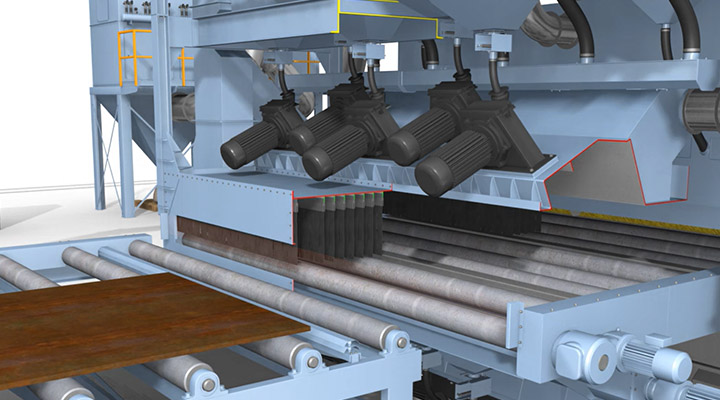
You must control several parameters to get the surface finish you want. Each one affects the final result in its own way.
Parameter | Function | Impact on Surface Finish |
|---|---|---|
Conveyor Speed | Sets how long the workpiece stays in the blast zone | Slower speeds allow more abrasive impact, creating deeper profiles; faster speeds lower cleaning intensity |
Abrasive Flow Rate | Controls the amount of abrasive thrown per minute | Higher flow rates remove heavier contamination; lower rates suit lighter cleaning tasks |
Wheel Power | Sets the speed at which abrasive hits the surface | Greater power produces stronger impact, ideal for removing thick rust or mill scale |
You should adjust these parameters based on your workpiece material and the surface profile you need. Steel plates with heavy rust need slower conveyor speeds and higher wheel power. Cleaner materials can move faster with less abrasive flow. The key is finding the right balance for your specific use. You can fine-tune each parameter on its own, so you can get consistent results across different workpiece types without stopping the production line.
Roller conveyor shot blasting machines give clear benefits for preparing many surfaces quickly. Automation cuts down on mistakes in the process. Even blasting gives the same finish on every part. This steadiness guarantees steady surface roughness and reliable Sa2.5 preparation standards. Manual ways like sandblasting cannot repeat this over and over. The skill of the worker decides the quality of each part. The roller conveyor machine gets rid of that need. You lower work costs, and upkeep stays low with the closed-loop abrasive recovery system.
You get more done with continuous processing. Parts go into the blast chamber one after another with no stops. Auto blasting gives more consistent results than manual methods. The machine uses the same settings for every part. Conveyor speed, abrasive flow, and wheel power stay the same. This steadiness is perfect for making many identical parts like steel plates. Your coating process works better with a uniform surface. The automated system also cuts down on worker tiredness and dangers from manual blasting.
You need to know how these machines are different. Knowing the difference between Crawler-Type and Hook-Type machines helps you choose. Both types work well for cleaning complex parts in batches. Crawler-type machines tumble small castings and forgings. Hook-type machines hang odd-shaped weldments on a turning hook. Both clean one load of parts at a time. Knowing their limits helps you avoid picking the wrong machine.
Roller conveyor machines are great for continuous inline work. Use them for flat or long materials. Steel plates, H-beams, profiles, and pipes ride on rollers through the machine. The nonstop movement makes roller conveyor the better choice for these parts. Your production goals decide which type works best.
Industries that like roller conveyor machines include shipbuilding, steel centers, car makers, and oil pipeline companies. Structural fabricators use the Q69 series for steel building parts. These industries need steady output and even surface quality over long runs.
When you compare the types, the choice depends on the shape of your parts. Complex parts do well in batch processing. Flat and long parts do well in continuous flow. Crawler-Type and Hook-Type work well for their own jobs but cannot match the output of roller conveyor machines.
Every roller conveyor shot blasting machine depends on several main parts that work together. Each part has a clear job in giving you even surface results. Knowing these parts helps you judge machine quality and choose wisely when buying.
Component | Main Job in Fast Surface Cleaning |
|---|---|
Blast Wheel | Shoots abrasive at high speed to clean surfaces |
Abrasive Supply System | Controls media flow for steady impact |
Recovery System | Gathers used abrasive for reuse, so work never stops |
Separator | Removes broken media and dirt to keep quality high |
Dust Collector | Traps dust in the air for a safe, clean workspace |
Conveyor System | Moves workpieces through the blast area on its own |
The blast wheel is the machine's core. The WWA380 blast wheel stands out for its high performance. This part throws abrasive particles at set speeds to cover the whole workpiece evenly. Its design uses less energy while still hitting hard. You get steady cleaning results without wasting power on uneven abrasive spread.
The recovery system keeps the machine running without stops. After abrasive hits the workpiece, gravity pulls it down to the chamber floor. Screw conveyors then carry the used media to a bucket elevator. This elevator lifts the abrasive to an air-wash separator at the top. The separator takes out broken pieces, dust, and dirt from the reusable media. Only clean, whole abrasive goes back to the blast wheel for the next round.
This closed-loop recycling system saves you real money. You waste less material because the same abrasive works for many cycles. The steady recovery also removes the need to stop and collect media by hand. Your line runs all the time, which raises output and lowers cost for each part.
The roller conveyor must handle the weight and size of your workpieces. Heavy-duty models use strong rollers with tough bearings to carry big loads. Variable frequency drives let you set conveyor speed with precision. This flexibility works for different material thicknesses and surface finishes. You can process thin sheets and thick steel beams on one machine without changing setups.
Dust collection keeps workers and the environment safe. The machine uses sealed chambers to hold dust inside during blasting. A pulse cartridge filter system traps dust with high efficiency. These filters catch 99.9% of particles before clean air leaves the machine. This helps you meet EPA and OSHA rules.
The dust system also helps with waste control. It stops harmful dust from building up in the work area. A full exhaust system catches leftover particles during the whole process. You keep a safe workspace while following environmental rules. This full dust control makes the machine fit for use even in areas with strict environmental limits.
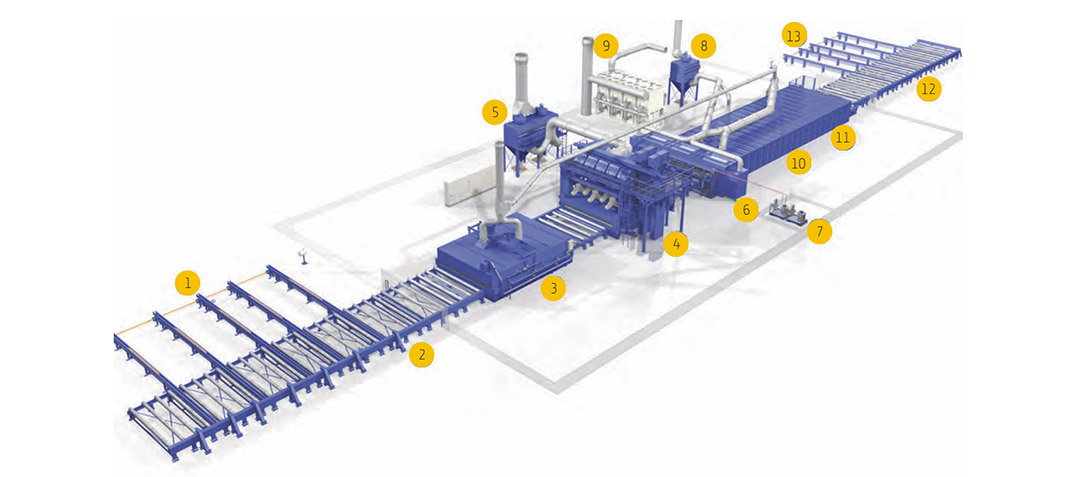
Picking the right roller conveyor shot blasting machine means looking closely at what your production needs. You have to match what the machine can do with the size and shape of your parts and how much you need to make. If you pick wrong, you get poor cleaning, slow production, and expensive downtime. Let us look at the main things you should think about.
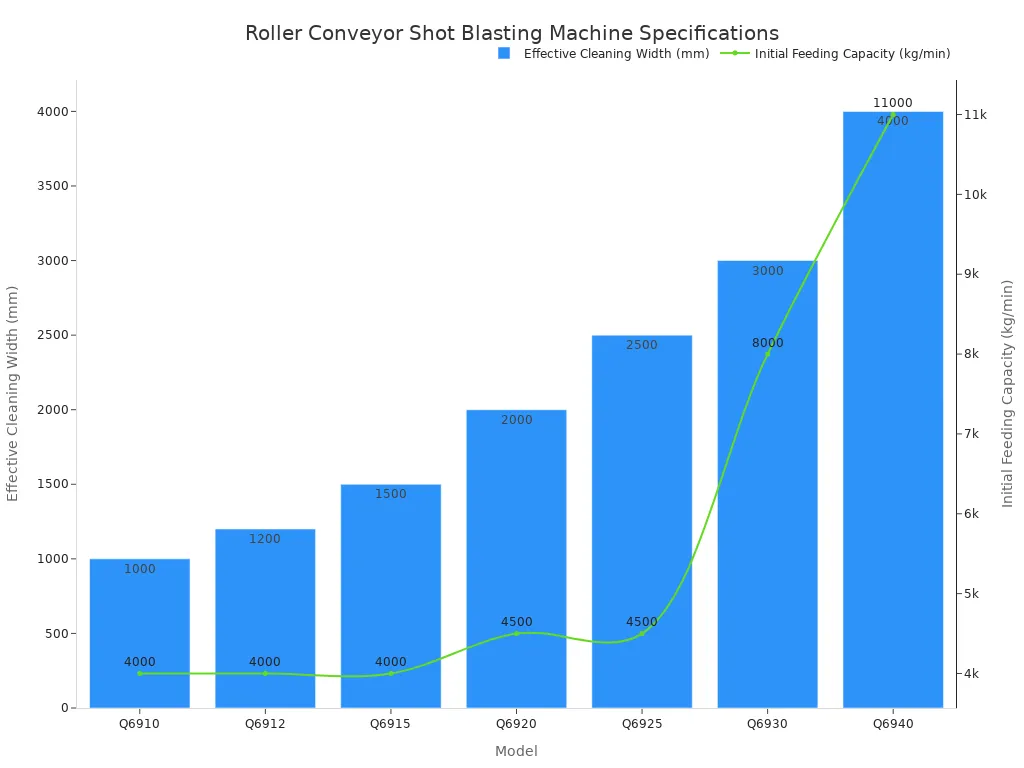
Start by measuring your biggest workpiece. You need to know the widest, thickest, and heaviest parts you will clean. These numbers tell you how wide the conveyor must be and how much wheel power you need. The table below shows how the Q69 series models fit different workpiece sizes.
Model | Effective Cleaning Width (mm) | Initial Feeding Capacity (kg/min) |
|---|---|---|
Q6910 | 1000 | 4000 |
Q6912 | 1200 | 4000 |
Q6915 | 1500 | 4000 |
Q6920 | 2000 | 4500 |
Q6925 | 2500 | 4500 |
Q6930 | 3000 | 8000 |
Q6940 | 4000 | 11000 |
The Q6940 model gives you the widest cleaning area at 4000 mm. It also takes the heaviest feeding load at 11000 kg per minute. If you clean steel plates up to 2500 mm wide, the Q6925 works well. The chart below helps you see how cleaning width and capacity relate.
Next, think about how many parts you need to finish each hour or day. More parts mean you need more blast wheels, faster conveyor speeds, and stronger abrasive recovery systems. Standard models handle medium amounts well. High-performance models with multiple turbines fit large, nonstop operations. Also plan for future growth. Buying a machine that handles 20 percent more than you need now saves you from buying another one later.
Your part shape matters too. Steel beams, flat plates, and thin parts each need different machine setups. Tall profiles need special multi-angle blast wheel placement. Flat parts work fine with standard overhead wheel setups. Think about how automated you want the machine. PLC controls, automatic abrasive recycling, and conveyor automation boost consistency and output. Avoid common errors like picking the wrong machine type or not planning enough dust collection.
Your surface finish goal drives which abrasive you choose. You need to know the target cleanliness level and surface profile roughness. Sa2.5 is the standard for painting. Shot blasting and grit blasting do different jobs. The table below shows which method fits your need.
Requirement | Recommended Method | Reason |
|---|---|---|
Smooth, uniform surface cleaning | Shot Blasting | Steel shots provide consistent impact and a cleaner finish. |
Stronger coating adhesion | Grit Blasting | Angular grit creates a deeper profile for better bonding. |
Continuous production processing | Shot Blasting | Automated machines suit large-volume manufacturing. |
Heavy corrosion or old coating removal | Grit Blasting | Cutting action of grit removes difficult defects effectively. |
Metal surface strengthening | Shot Blasting | Controlled impact improves fatigue resistance. |
Grit blasting is better when you need a rougher surface profile. The sharp abrasive particles make a coarser texture. This helps protective coatings stick better to the surface. It matters most for materials that need strong coating grip in marine, pipeline, and industrial maintenance work.
Your workpiece material also changes the machine setup. Standard machines work fine for carbon steel. Aluminum-magnesium alloys need special explosion-proof designs. Wheel offers these special setups to keep things safe. The abrasive recovery system, dust collection, and chamber seals all meet safety rules for flammable materials.
Think hard about the dust collection system. Getting the right size keeps you within environmental rules and helps the machine last longer. A pulse-jet bag filter usually handles the dust from nonstop work. Match the filter size to how much abrasive you use and how dirty your parts are.
Last, check the automation level. PLC controls keep settings steady across all production runs. Automatic abrasive recycling cuts waste and labor costs. Conveyor automation connects smoothly with your current production line. The right mix of size, output, abrasive, and setup gives you a machine that works well for years.
Roller conveyor shot blasting machines deliver the best results for high-volume surface preparation of flat and elongated parts. You gain continuous automation, consistent finishes, and lower labor costs. Matching machine specifications to your production needs ensures reliable performance for years.
Wheel (Changzhou) Intelligent Manufacturing Co., Ltd. offers customizable solutions, including the RBS series. Advanced technology and global support back every machine. Contact Wheel today for a detailed consultation, site assessment, or quote. Optimize your surface preparation process with equipment built for your exact requirements.
Check wear parts every day. Look at blast wheel blades, conveyor rollers, and chamber liners for damage. Do full preventive maintenance every 500 hours of use. This means greasing bearings, checking the elevator belt, and testing separator performance. Regular upkeep stops surprise breakdowns and makes the equipment last longer.
You can hit a Sa2.5 cleanliness level every time. This standard means the surface looks like near-white metal with no oil, grease, or mill scale visible. The machine gives the same surface roughness on every part. This steadiness ensures good coating grip for painting or powder coating jobs.
Steel shot is best for cleaning and making surfaces stronger. Steel grit makes a rougher texture for better coating grip. Pick shot for thin materials that need little surface change. Choose grit for heavy rust removal or when you need the strongest coating hold. Your target surface profile tells you what to use.
Yes. Wheel provides many customization choices. You can change conveyor width, blast wheel number, and chamber height to fit your parts. For aluminum-magnesium alloys, you need an explosion-proof setup. This design uses sealed electrical parts and special dust collection to stop fire risks during blasting.
Whatsapp: +86-13115294491
E-mail: kanas@blastingwheelgroup.com
ADD: No161, Han Jiang West Road, Xinbei District, Changzhou City, Jiangsu Province, China
Mobile: China: 0086-13115294898 ; International: 0086 13115294491


